The Ultimate Beginner’s Guide to the Gym

So you’ve decided to start the gym (or get back into it). You’re not sure where to begin, and maybe you’re feeling a bit overwhelmed. This is normal. Most people walk into the gym for the first time and immediately forget why they’re there. Some remember eventually. Some just stretch for 20 minutes and go home.
This article will give you the knowledge, reassurance and steps to feel confident every time you walk into the gym - or at least confident enough that no one will suspect you’re internally spiralling. That’s really the benchmark.
You don’t need to know everything to start. Realistically, a lot of people at the gym don’t know what they’re doing either. Some have been confidently guessing for years. One or two may even offer advice based on these guesses. It’s a fascinating ecosystem.
Now lets get into it.
Set Clear, Simple Goals
Once you know what you’d like to achieve, set yourself a clear and measurable goal. One or two goals are enough to begin with. Any more than that and you’re essentially creating a full-time job for yourself, unpaid, with questionable benefits.
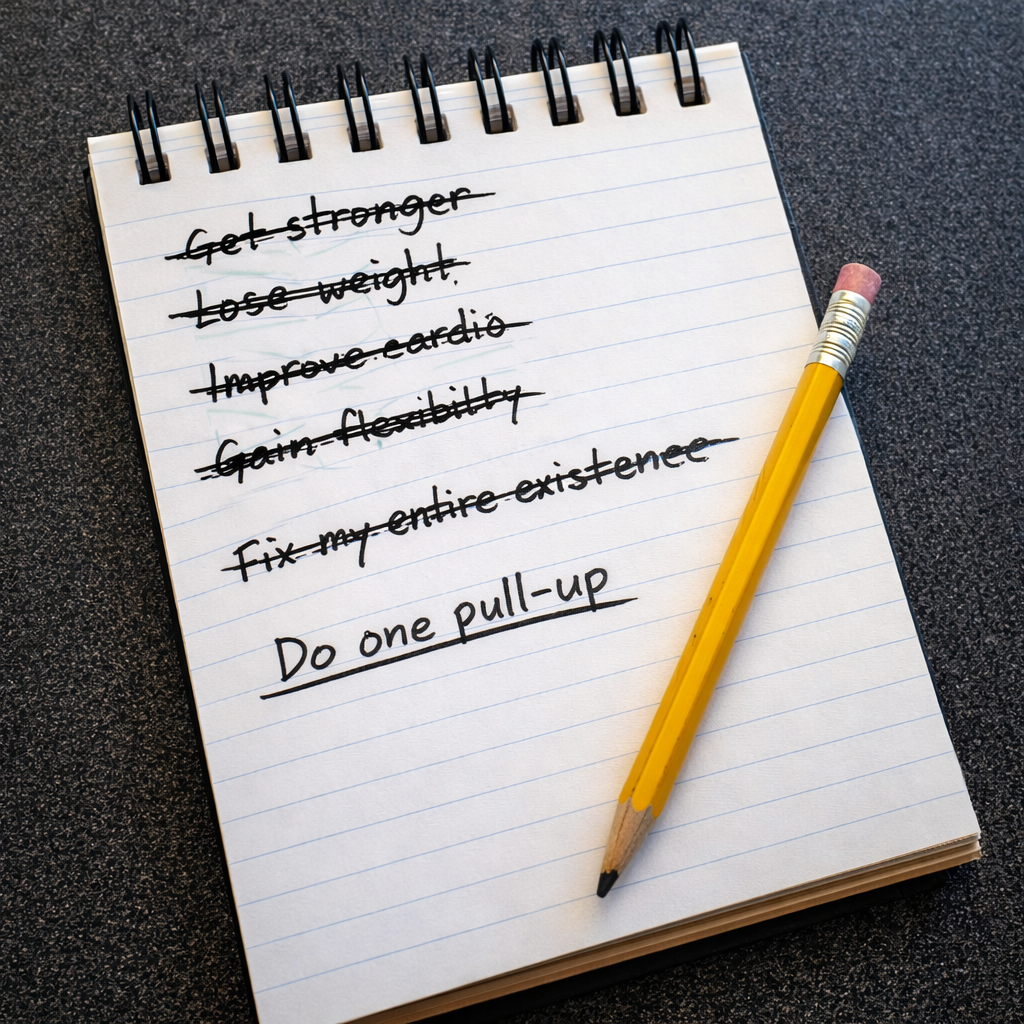
An example of a goal for strength or muscle gain would be “achieve one pull-up.” It’s measurable, realistic, and universally humbling. Also, it gives you something very specific to celebrate when it finally happens. And you have a party trick when people don’t believe you can.
Avoid going to the gym with goals like “get stronger, lose fat, improve cardio, gain flexibility and… fix my entire existence.” There’s simply too much going on, and your training will end up reflecting that - scattered, confusing, and possibly featuring exercises you don’t remember choosing.
A good programme will naturally help with most of those things anyway, without requiring you to pretend you’re training for a decathlon you didn’t sign up for.
How Often Should You Train?
You may have already Googled or asked people, “How many days per week is optimal?” The answer is nuanced and depends on your schedule, lifestyle, age, and roughly a dozen other factors you probably didn’t want included in the equation.
Before worrying about “optimal,” ask yourself a simpler question: How many days can I 100% commit to without inventing creative excuses?
For most people, this number is lower than expected. Sometimes dramatically lower.
You’re far better off committing to a three-day-a-week routine you can actually stick to than aiming for five days and abruptly discovering you are “unexpectedly busy” every second day. Consistency beats ambition, especially when ambition keeps forgetting its gym bag.
How long should each session be?
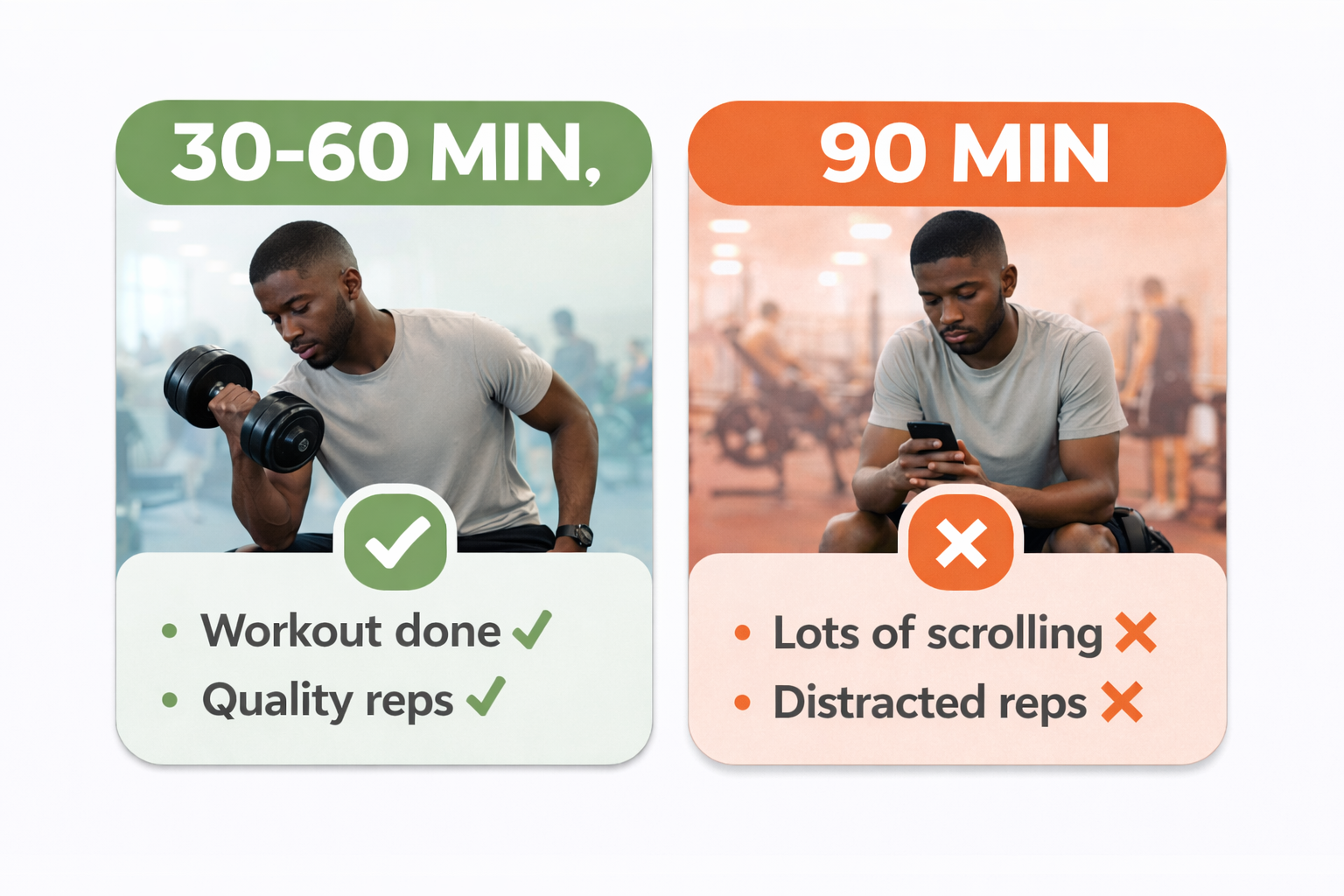
Honestly, it depends on your schedule. People get caught up thinking they need 90-minute sessions to make progress, but that’s mostly background noise generated by individuals who apparently live at the gym and have nowhere else to be.
If you can consistently give yourself 30–60 minutes, you’re fine. Hit your main lifts, push yourself with good form, and try not to spend half your session scrolling as if your phone is part of the workout. Whether you’ve got half an hour or a full hour, commit to it and get the session done.
The Core of Beginner Training: Compound Lifts
The key movement patterns for resistance training are:
• Squat
• Hinge (deadlift variations)
• Horizontal and vertical push (bench press, overhead press)
• Horizontal and vertical pull (rows, pulldowns)
Each workout should include at least one of these movements, ideally near the start, before your energy levels quietly abandon you.
To begin with, these don’t need to be done with barbells or dumbbells. You can use machines while you gain confidence, coordination, and the ability to walk into the free-weights area without feeling like you’re trespassing on someone else’s territory. Machines are perfectly fine, in fact they aren’t inferior — they exist for a reason, and not just as decoration.
A Simple, Foolproof Beginner Workout Plan
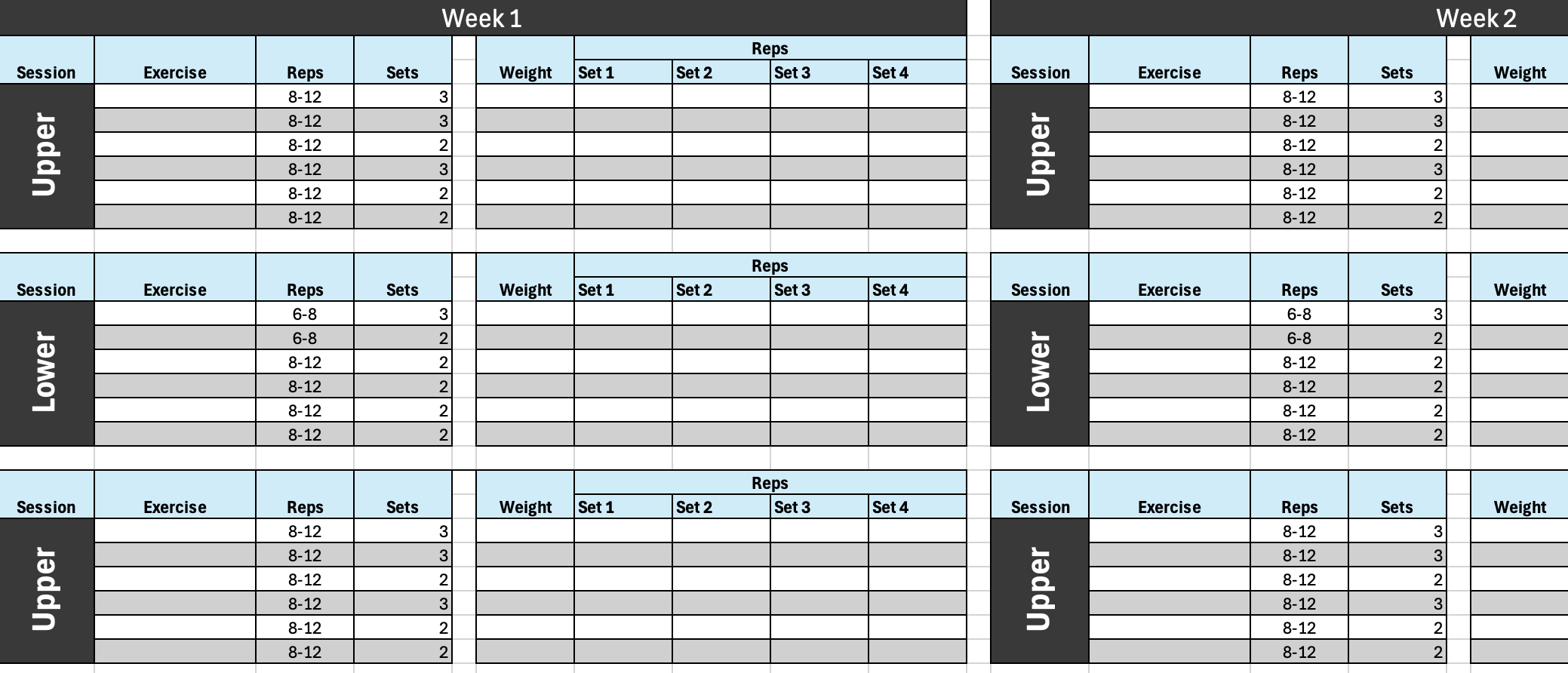
I have put together a simple beginners plan that will get you great results when you’re starting off. It’s an excel spreadsheet you can use to track your lifts. I’ve also included an exercises tab with links to videos to show you the correct form for each lift.
So if you want something simple, that just works, give it a go!
Form Basics (What Beginners Always Get Wrong)
Full range of motion
Use the full range of motion for the exercise. Partial reps have their place, but that place is usually later, not on day one. If the weight only moves halfway because that’s all it allows, the weight is too heavy.
Stable core & bracing
Your core’s job is to keep you stable, not to visibly struggle through the set. Brace as if you’re about to be lightly pushed, not as if you’re preparing for impact. If everything feels wobbly, unstable, or unnecessarily dramatic, something probably needs adjusting.
Control the negative
Lower the weight with intent. Letting gravity do all the work may feel efficient, but it’s not the goal. If the weight is dropping faster than you are, you’ve lost control of the set. Slow it down. The muscles are supposed to be involved the whole time.
Avoid ego lifting
If your form changes significantly when the weight increases, the weight has won. This happens to everyone at some point. The solution is not to fight harder - it’s to reduce the load.
Machine setup matters
Take 30 seconds to set the machine up properly. Adjust the seat height, line the handles up with the joints you’re using, and place your feet where they actually support you. Machines aren’t “plug and play,” and ignoring the setup doesn’t make you advanced — it just makes the exercise feel weird for reasons that were avoidable. On some machines, I like to note down what settings I have them on so that the exercise is consistent week to week.
If you’re still not sure, download my free beginner plan above where I have added form videos for each exercise.
Progressive Overload: The Rule That Actually Changes Your Body
Progressive overload is one of the most important parts of resistance training. Without incorporating it into your sessions, you are leaving results on the table. It is doing a little bit more every session than your previous one.
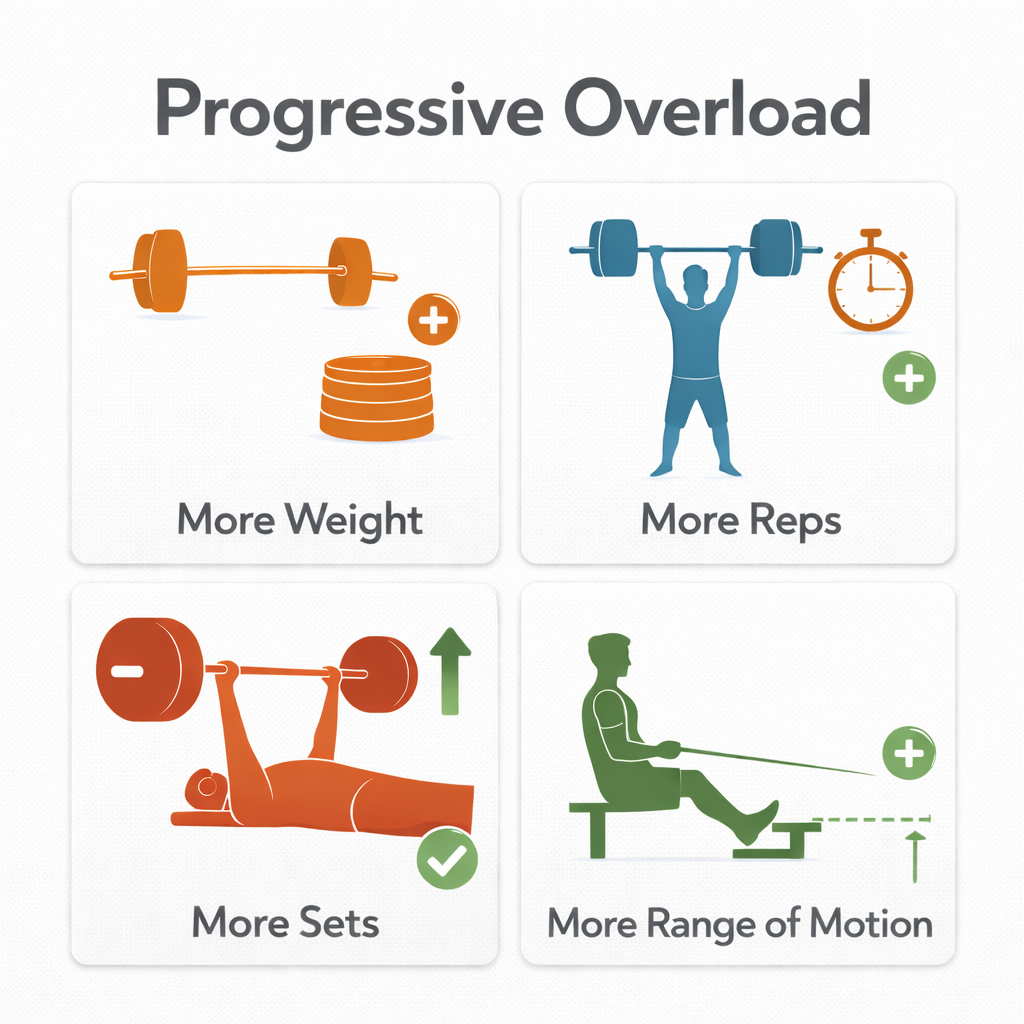
This doesn’t mean that in a year you’ll be stuck in the gym for 2 hours. It’s small steady increases in either the amount of reps, weight, sets or even slower reps.
If you want to find out more about progressive overload I have an article on it here
How to Warm Up Properly
Warming up is important to help reduce the risk of injury but you also don’t want to be stuck warming up for 15 minutes when you only have 45 minutes to work out.
Starting off with 5 minutes on a cardio machine, slowly progressing the intensity until you’ve got your heart pumping is sufficient.
When you move onto the weights, you don’t want to go straight into your working set (the set you do that you struggle with). As a beginner, you’re probably not lifting huge weights to begin with, so one warm up set should be ok with about 80% of the weight you normally do. The heavier you go, the more warm up sets needed.
Example:
You’re warming up for dumbbell bench press and you usually do 20kg per dumbbell and you’re aiming for 10 reps.
Warmup Set 1 - 10kg - 8 reps
Warmup Set 2 - 16kg - 4 reps
Working Set 1 - 20kg - 10 reps
Nutrition for Beginners

ChatGPT refused to spell carbohydrates right
Heres is a quick list of key areas you need to be mindful of with your nutrition when you start the gym.
Protein = 1.6-2.2/kg or body weight per day
Carbs and Fats = base these on your weight goal depending on if you’re trying to gain or lose weight.
Hydration = Get at least 3 litres of water in a day. (0.8 in freedom units)
Eat whole foods as much as possible
High fibre
Get your fruit and veg in!
For more depth, I have two articles you can go to based on what your goals are in the gym.
How to build muscle here
How to lose weight here
Nutrition doesn’t need to be perfect, we all love a pizza or an Indian takeaway now and then. If you’re doing the above, you’re going to make great progress.
Supplements (What’s Worth It and What’s a Scam)
Supplements should be exactly what they are called. A supplement to your already healthy diet and not your focus.
I have an article that breaks down what supplements are actually needed and what supplements are a waste of money here.
Spoiler: most supplements are a waste of money. However, protein powder, creatine and caffeine are the most supported supplements.
Gym Confidence + Mindset for First-Timers
One of the most common things that beginners say before they start the gym is they are worried about people watching them or making fun of them.
This could not be further from reality. A few sessions into the gym you will realise that people are not interested in what exercise you’re doing and are focused on themselves. You may lock eyes with people now and then but that’s just people looking around in between sets just like you’ll be doing.
I experienced how much people aren’t looking at you when I failed a heavy rep on bench press and had the bar stuck on me for what felt like 5 minutes because nobody noticed. (Always have a spotter on bench press when you’re a beginner).
A barbell stuck on me with me, legs sprawled out and no one bats an eyelid. Think about that the next time you think people are looking at you when you’re trying a new exercise for the first time.

Plan your session. Walk into the gym knowing what exercises you are doing that session. You will feel more confident walking in and being in the gym when you know what you’re doing that day.
Sometimes the machine you want to do may not be free. That’s fine, you can do another exercise you have planned instead. Or if you’ve noticed they’ve been on the machine for a while, just ask them politely how many sets they have left, they won’t mind. Most people aren’t on a machine for longer than 10 minutes.
Also don’t panic when somebody asks you that same question. They aren’t trying to rush you. Just be polite back and let them know how long you may be, your workout is just as important as anyone else’s.
You may also have somebody ask you to “work-in” with you. This is them asking if they could use your machine whilst you are resting. Whether you want to let them or not is up to you but it’s a good way to make a gym friend.
Gym etiquette
If you do find people looking at you, it could just be because you’ve unknowingly had bad gym etiquette. Some things you just won’t know unless someone tells you. Here are the main things beginners or even some experienced gym goers do that you should avoid:
If you’re sweaty, bring a towel and wipe down the machine after you.
Re-rack your weights in the correct place - the world would be a better place if everybody did this.
Don’t do your exercises right in front of the dumbbell rack, blocking people from using the dumbbells in front of you.
Try not to block somebody else’s view of the mirror
Don’t spend 5 minutes in between sets on a machine scrolling on your phone or chatting. Somebody may be waiting for the machine you’re using. 2/3 minutes is fine, don’t go overboard.
Recovery: The Most Underrated Beginner Skill
Don’t underestimate recovery. I have an article going into more depth on recovery here, on point 3.
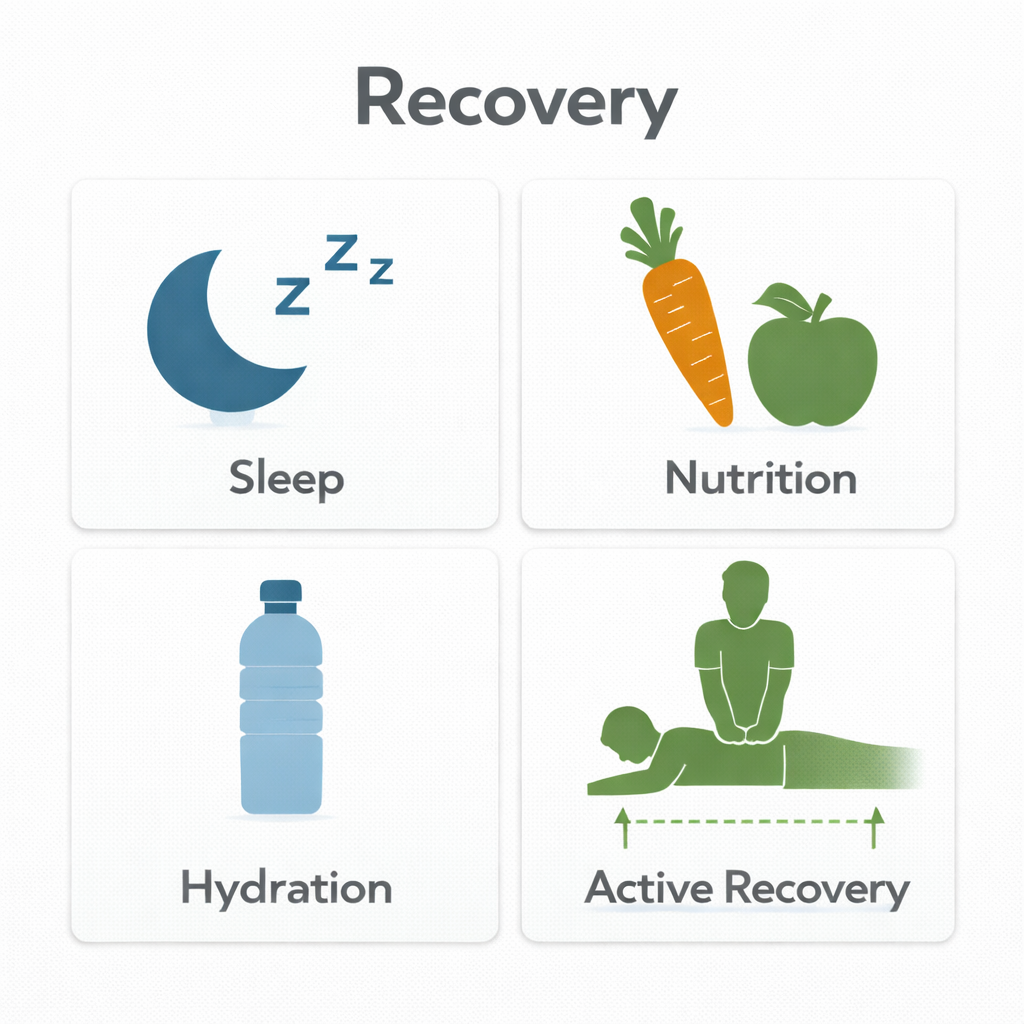
Here’s an overview
Sleep 7-8 hours
Rest days are important
The more sore you are after a workout doesn’t mean the better the workout
Active rest days are great, getting steps in, small amount of cardio or just stretching works well.
Life can be stressful at times. Try to manage your stress (i know, easier said than done)
Avoid overtraining. Don’t go into your gym session training a muscle that already feels sore.
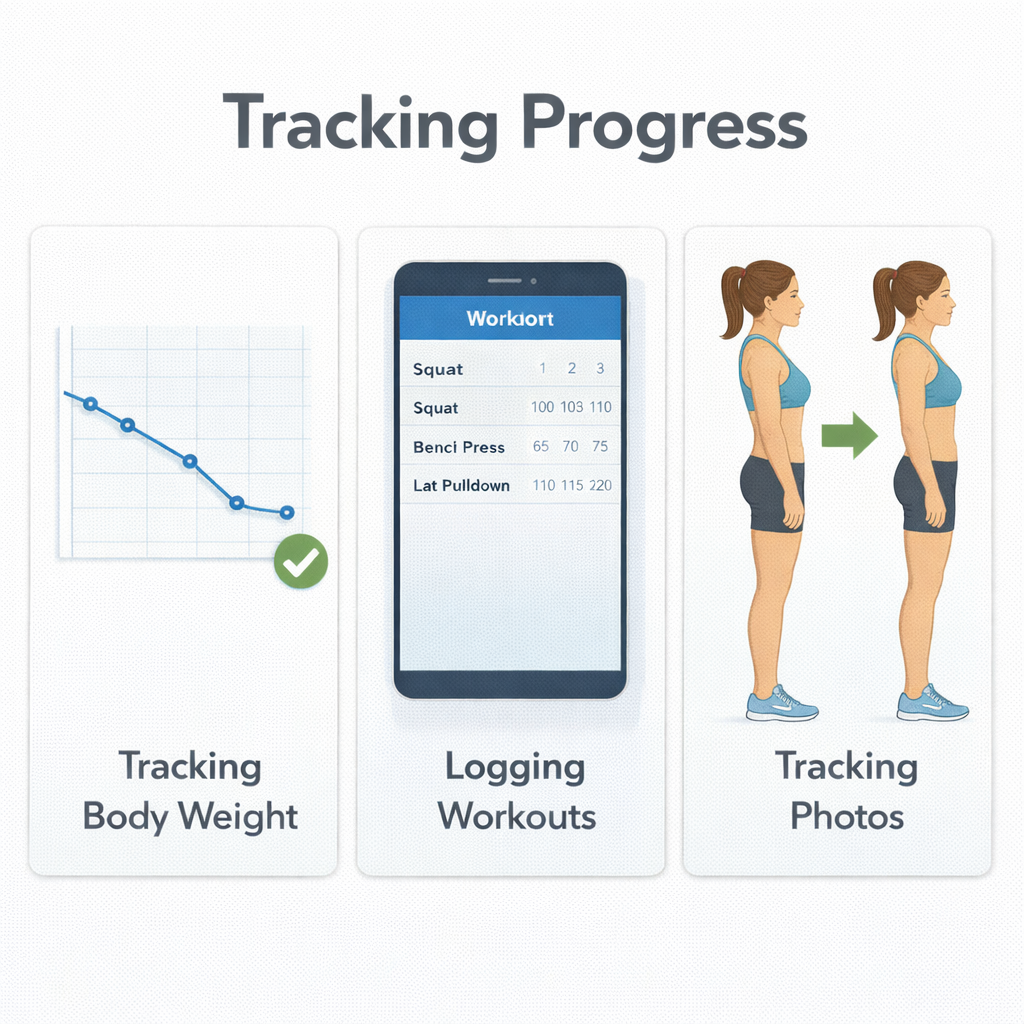
Weight
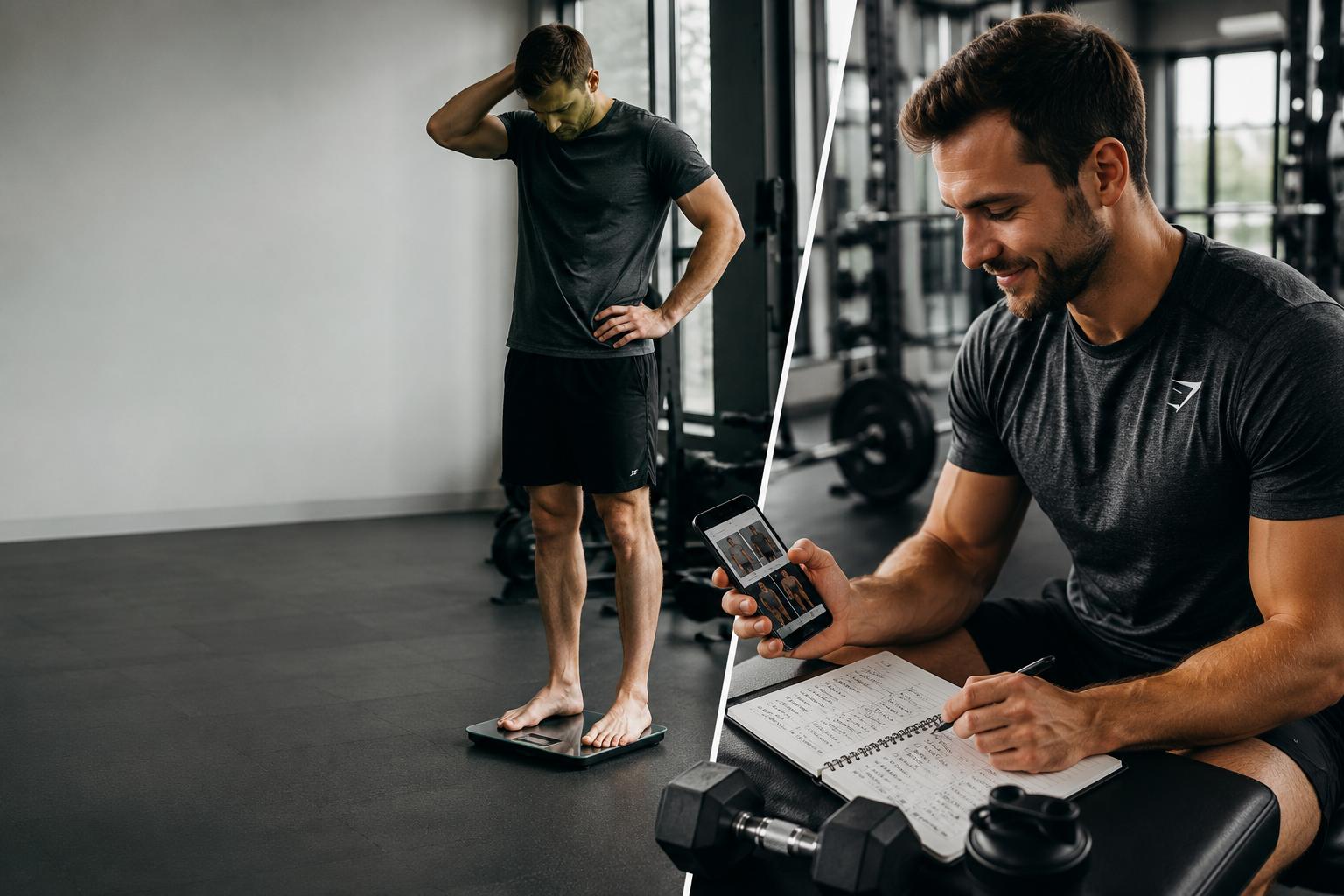
You should weigh yourself - just not in a way that sends you spiralling.
Weighing in 3–4 times per week is far better than once a week. A single weigh-in can be wildly misleading. One week you step on the scale after a light day and you’re two pounds down. The next week it’s after a pizza and a full system — and suddenly you’re heavier. Nothing meaningful has changed. The scale just caught you on a different day.
More frequent weigh-ins show the trend, not the nonsense. The trend is what matters.
Performance
If you don’t track what you lift, you end up guessing. And if you guess for a few weeks in a row, there’s a good chance you’re lifting the same weights you were when you started. Writing down exercises, weights, and reps gives every session a target.
It also gives you proof of progress when things slow down — instead of convincing yourself it’s not working and quitting.
Photos
You see yourself every day. Your mirror lies by default. Muscle gain is slow, subtle, and easy to miss. Progress photos taken every 4–6 weeks, in the same lighting and pose, make changes obvious.
When the scale is unhelpful, photos usually tell the truth.
Common Beginner Mistakes
Changing program every week - stick to your programme for a minimum of 8 weeks. 12 weeks is perfect.
Doing too many exercises - ever heard of too many cooks spoil the broth? Well that, but exercises… kinda. When you’re new you’re learning a lot. 6 different exercises a session is perfectly fine.
Not eating enough protein - don’t go hard for an hour in the gym only to eat 32 grams of protein daily and make it even harder for yourself.
Comparing yourself to experienced lifters - there will be a point when you look in the mirror with two 10kg dumbbells and you see the guy next to you doing the same exercise with 30kg dumbbells. It can make you feel like you have the strength of an 8 year old. It’s ok, that guy started where you did. Your progression will be fast since you’re a beginner. The following week he might make you feel like a 12 year old instead.
Training to failure every set - it sounds like going as hard as possible every set will yield the best results doesn’t it. Fact is, it doesn’t work like that. Training to failure every single set will make your recovery a lot harder. It could be effective if you’re doing 5 working sets per session. However, I would not advise that for a beginner. Leaving 1-2 reps in the tank is the advise I give for the majority of your sets as a beginner. Learn your form, train hard, recover.
See more mistakes on my How to build muscle fast (the right way) article.
Don’t worry if you’re making these mistakes or about making them in general. Everybody makes mistakes in all walks of life. You won’t believe the amount of typos I made in this artilce.
Final Words
If you take one thing from this, let it be this: progress takes time.
The scale will jump around. The mirror will mess with your head more than your ex. Some weeks will feel like nothing is happening. That doesn’t mean nothing is happening. When you weigh yourself consistently, track what you lift, and use photos instead of emotions, you stop relying on feelings - and start relying on evidence. Promise I’m not a lawyer.
Beginners don’t fail because they aren’t working hard enough. They fail because they don’t give the process enough time.
You don’t need to master everything, you just need to show up and learn as you can.
No one starts as a pro.
Most importantly, enjoy the process.