
What Is the Best Workout Split? (How I Design Programs for My Clients)

One of the questions I get asked the most is “what is the best split?” or “what split are you on at the moment? So what uis best? Push, pull, legs? Upper/lower? Full body? The classic “bro split?
If you’re looking for the single best workout split, I’ve got some bad news: there isn’t one.
There is, however, a best workout split for you.
When I design a programme for a client, I don’t have a collection of pre-written programmes where I think, “They can train three days per week, so they can have push, pull, legs,” or “Four days? Upper, lower, upper, lower.”
Your programme should be built around you, not the other way around. Don’t just pick a split because your favourite influencer is doing it and think it is going to get you far more gains than any other split.
So before worrying about which split you should follow, there are a few questions I think you need to answer. These are the questions I always ask clients before putting together their workouts.
1. What is your goal?
This should always come first.
Why are you lifting weights?
Do you want bigger legs? Bigger arms? Are you trying to improve your bench press? Is building your chest the priority? Or do you simply want to build a strong, well-rounded physique?
Once we know that, we can start designing the programme around it.
If somebody tells me their main goal is to grow their biceps, for example, I'm going to make sure their programme gives their biceps enough attention. I'm not going to blindly give them a standard workout split where biceps are thrown in for a couple of sets at the end of a pull workout.
In fact, if their back is already well developed but their biceps are the priority, I might put their biceps exercises before their back exercises.
Your priorities should influence both how much work a muscle gets and where that work appears in your workouts.
When I'm writing a programme, the client's goals and priority lifts are therefore some of the first things I put in. I then build the rest of the programme around them.
2. How many times can you actually train?
Not how many times you'd ideally like to train. If someone tells you that you have to train 5 times a week to gain muscle, do me a favour, and stop listening to them.
How many times can you realistically get to the gym every week?
If the answer is three, I'm going to write you a three-day programme.
There's very little point in me writing the world's greatest four-day programme if you only ever complete three days of it.
Imagine your main goal is growing your legs and you've decided to follow:
Legs → Push → Pull → Legs
On paper, you've got two leg sessions every week. Ideal that.
Except you can only realistically get to the gym three times most weeks.
You therefore keep completing legs, push and pull before missing the second leg session — the exact session that was supposed to prioritise your main goal.
The programme might look brilliant on a spreadsheet. In reality, it isn't doing what you designed it to do.
This is why one of the first things I establish with a client is a number of weekly sessions that they can consistently complete.
Consistency beats designing a theoretically perfect programme that doesn't fit your life.
3. How much time do you actually have?
Training frequency isn't the whole story.
Two people might both tell me they can train three times per week, but their programmes could still look very different.
One has 45 minutes before work.
The other has 90 minutes and isn't in any rush.
If your sessions need to be short, we might need to spread exercises differently, prioritise movements more aggressively or use exercises that allow us to get more useful work done within the time available.
Again, the programme needs to fit your life.
4. What are your limitations?
This is another reason I don't like blindly assigning people workout splits.
Let's say you're prone to problems with your lower back.
Outside of any specific work we're doing to address that issue, I need to consider how much stress the programme is placing on that area.
I probably don't want to programme heavy deadlifts, followed by Romanian deadlifts, followed by bent-over rows, followed by standing military presses and then wonder why your lower back is absolutely cooked.
None of those exercises are inherently bad.
The issue is their combined workload in the context of that particular person.
The same applies to knees, shoulders, elbows or any other limitations.
Exercise selection shouldn't happen in isolation. Every exercise needs to make sense alongside everything else you're asking your body to do.
5. What else do you do outside the gym?
Your body doesn't know that your gym programme exists on a nice little spreadsheet separate from the rest of your life.
If you're a keen runner, play football twice per week or participate in another sport, I want to know about it.
Let's say football is your priority and you play every Saturday.
Putting your hardest leg session on Thursday or Friday would be ridiculous from me.
We might instead put the main lower-body session earlier in the week, giving you time to recover before playing.
Likewise, someone running several times per week might need their lower-body gym volume distributed differently from somebody whose only exercise is resistance training.
Your gym programme should complement the rest of your training rather than compete with it.
6. How well can you recover?
This overlaps with the previous point, but it's worth considering separately.
Your training programme isn't just determined by how much exercise you can physically fit into your calendar.
Sleep, stress, your job and other physical activity all influence how much training you can realistically recover from.
Someone with a physically demanding job, poor sleep and several sports sessions each week shouldn't necessarily follow the same programme as someone with excellent recovery and very little activity outside the gym.
More training isn't automatically better.
We want enough training to drive progress while still allowing you to recover from it.
7. What do you actually enjoy doing?

This one sometimes gets forgotten when people start talking about "optimal" training.
You are allowed to enjoy the gym.
If you absolutely love bench pressing, I'm going to try to get bench pressing into your programme.
If improving it is important to you, perhaps we'll bench twice per week.
If you love training arms and genuinely look forward to an arm session, there is nothing wrong with having an arm day if it works within the rest of your programme.
And the opposite applies too.
If you absolutely despise leg day, why write a programme containing one enormous leg session that you dread every week?
We could distribute that work.
Perhaps you squat and perform leg curls on your shoulder day, then do leg presses and leg extensions alongside your arm workout.
You're still training your legs. We've just spread the work across the week instead of creating one massive session that you hate.
Is that how I'd structure everyone's programme? Nope.
But if it means you're more consistent and enjoy your training more, it's worth considering.
How often should you train each muscle?
You'll often hear that you must train every muscle twice per week to maximise muscle growth.
The evidence is a little more nuanced than that.
When total weekly training volume is matched, training a muscle more frequently doesn't appear to have a large independent effect on muscle growth.
That doesn't mean training frequency is irrelevant.
I think it's better to view frequency as a way of distributing your training volume.
Imagine we want to give your legs 16 challenging sets each week.
We could theoretically do all 16 on Monday.
But by the time you're deep into that session, fatigue is going to be accumulating and your performance is likely to drop.
Alternatively, we could perform eight sets on Monday and another eight on Thursday.
You arrive on Thursday recovered rather than performing set nine immediately after the first eight.
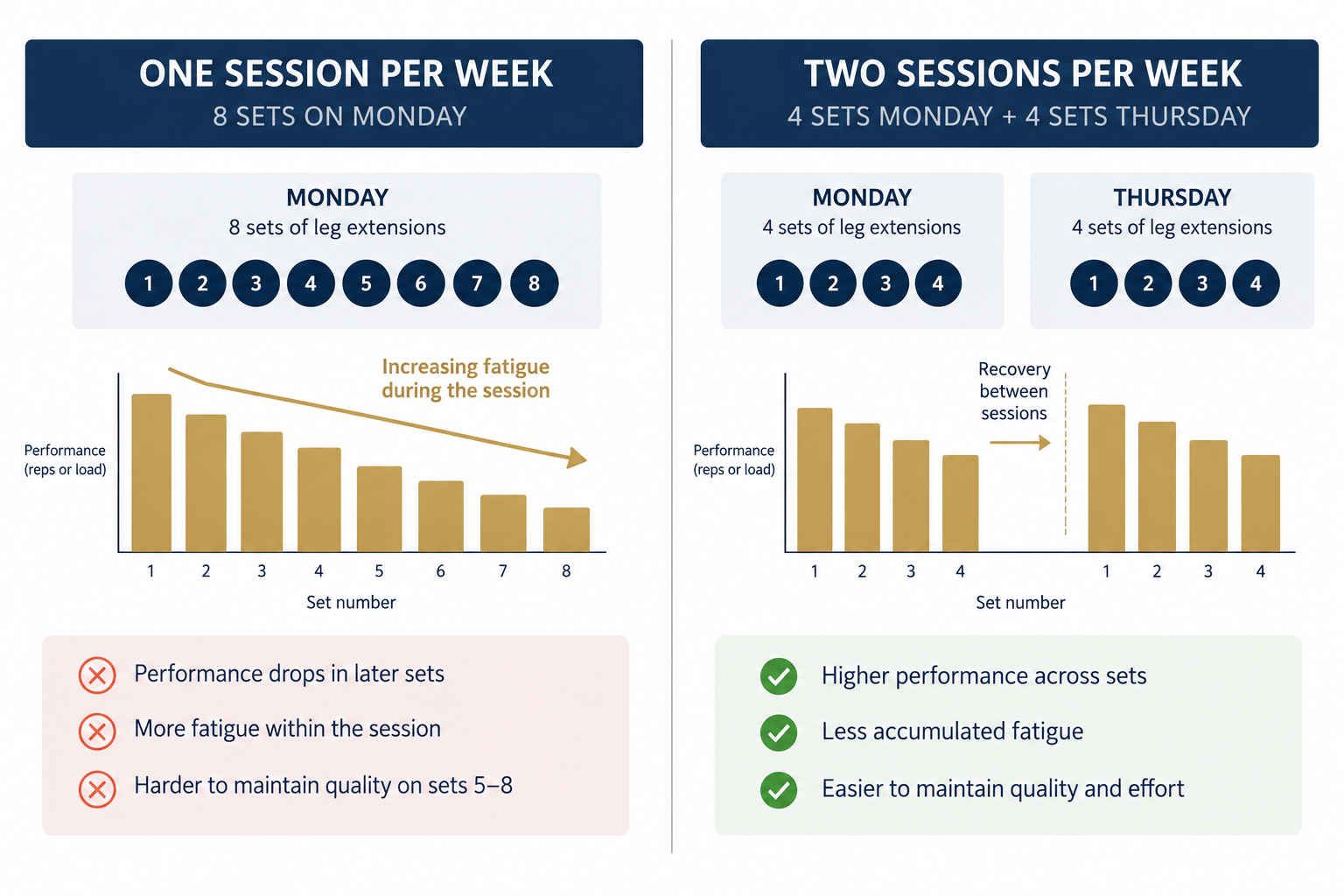
That's one reason I often like training priority muscle groups more than once per week. It's not because hitting a muscle twice has some magical muscle-building effect. It allows us to distribute the workload, manage fatigue and potentially maintain better performance across that work.
If a muscle only needs a relatively small amount of weekly work within your programme, putting it into one session may be absolutely fine.
Frequency is a programming tool, not a rule.
Prioritise what you actually want to improve
Once we've answered all of those questions, we can start putting the programme together.
Your main goals generally get priority.
If you want bigger biceps, don't automatically leave your curls until the very end of a long back workout when you're already fatigued.
We could train them earlier in the session.
We could also train them on two different days.
Likewise, if your chest is the priority, I might increase your chest volume, put your most important pressing movement early in your workouts and potentially distribute your chest training across multiple sessions.
Compound movements will usually form the foundation of programmes I write, with isolation exercises added according to the person's individual goals.
But even that isn't a rigid rule.
The programme exists to achieve the goal. The goal doesn't exist to justify the programme.
What about beginners?
If you're relatively new to resistance training, you probably don't need to overcomplicate any of this.
You don't need an incredibly specialised six-day programme targeting every conceivable angle of every muscle.
I'd rather see a beginner learn the major movement patterns, practise their exercises regularly, build good technique and progressively get stronger.
A simple full-body programme performed two or three times per week can therefore work brilliantly.
As you become more experienced and your goals become more specific, there may be more reason to specialise.
Maybe your legs are exactly where you want them but you want significantly bigger shoulders.
Maybe your overall physique is good but your bench press has stalled.
That's when we can start moving volume around and designing the programme more specifically around those goals.
I have a beginners workout programme free to download below. It’s nothing like a tailored programme, but it hits all body parts with sufficient volume and you can customise it to include the lifts you prefer.
So, what is the best workout split?
There isn't one.
Push, pull, legs can be great.
Upper/lower can be great.
Full-body training can be great.
A traditional body-part split can work.
And sometimes a programme that doesn't have a neat name at all is exactly what you need.
Before choosing your split, ask yourself:
What is my main goal?
How many times can I realistically train every week?
How long can I spend in the gym?
Do I have any injuries or limitations?
What other exercise or sport am I doing?
How well can I recover from my training?
Which exercises do I enjoy?
Which muscles or lifts do I specifically want to improve?
Then build the split around those answers.
That's essentially how I approach programming with my PT clients.
I don't decide that you need push, pull, legs and then try to squeeze your life into it.
I find out what you're trying to achieve, what you enjoy, what limitations we need to work around and how much training you can realistically commit to.
Then I design the programme around you.
