
Do You Need to Train to Failure? Understanding Reps in Reserve
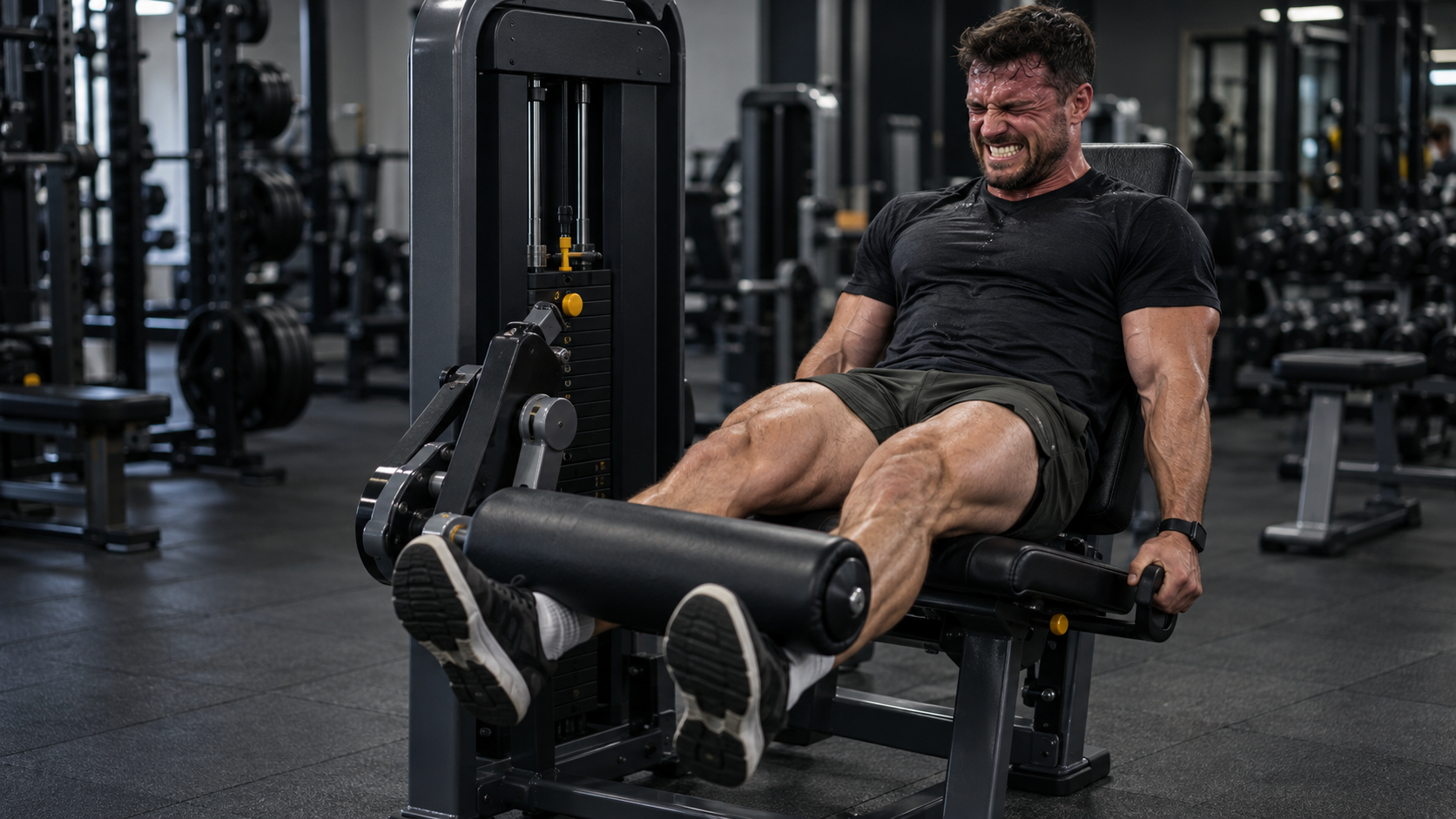
Do you need to train to failure to get as much out of your training as possible? Do you need to push every set until you’re red in the face, blood coming from your eyes, and feel like you’re about to shit yourself?
Short answer: no.
But you do need to understand what a genuinely hard set feels like. And that’s where things get a bit more interesting.
What does training to failure actually mean?
Say you’re doing bicep curls. You complete 10 reps, but there’s no way you could get an 11th even for 1 million quid without swinging like crazy to get the dumbbells up.
For the way I coach that exercise, that’s the end of the set. We’re counting full reps with the intended technique, rather than whatever movement gets the weight from A to B.
There’s a distinction between reaching muscular failure and stopping because your technique is breaking down. Either way, changing the exercise to squeeze out another rep isn’t what I’m asking for.
And stopping because a set burns or feels uncomfortable doesn’t necessarily mean you’ve reached either of those points.
What are reps in reserve?
One way we estimate how close a set is to failure is RIR, which stands for reps in reserve.
Essentially, how many more full reps could you have done?
0 RIR: you couldn’t complete another rep.
1 RIR: you could have completed one more.
2 RIR: you could have completed two more.
3 RIR: you could have completed three more.
You don’t have to attempt a rep and fail it to finish at 0 RIR. You might complete your final rep and have nothing left for another one.
The important word here is estimate. RIR isn’t something you can calculate perfectly just because you’ve written a number in your training log.
For example, if I’m programming three sets of bench press, I might ask someone to leave two reps in the tank on their first set, one on their second, and one or possibly zero on their third.
That depends on the person, the goal and the setup. It’s an example, rather than a rule that every final set needs to reach failure.
What does the research say?
Research involving Dr Martin Refalo gives us some useful evidence here.
A 2024 study led by Refalo followed 18 trained men and women for eight weeks. Each person trained one leg to failure and the other with two reps in reserve on leg press and one on leg extension.
Average quadriceps growth was very similar. However, training to failure caused greater immediate fatigue, measured through bigger losses in lifting speed and repetitions.
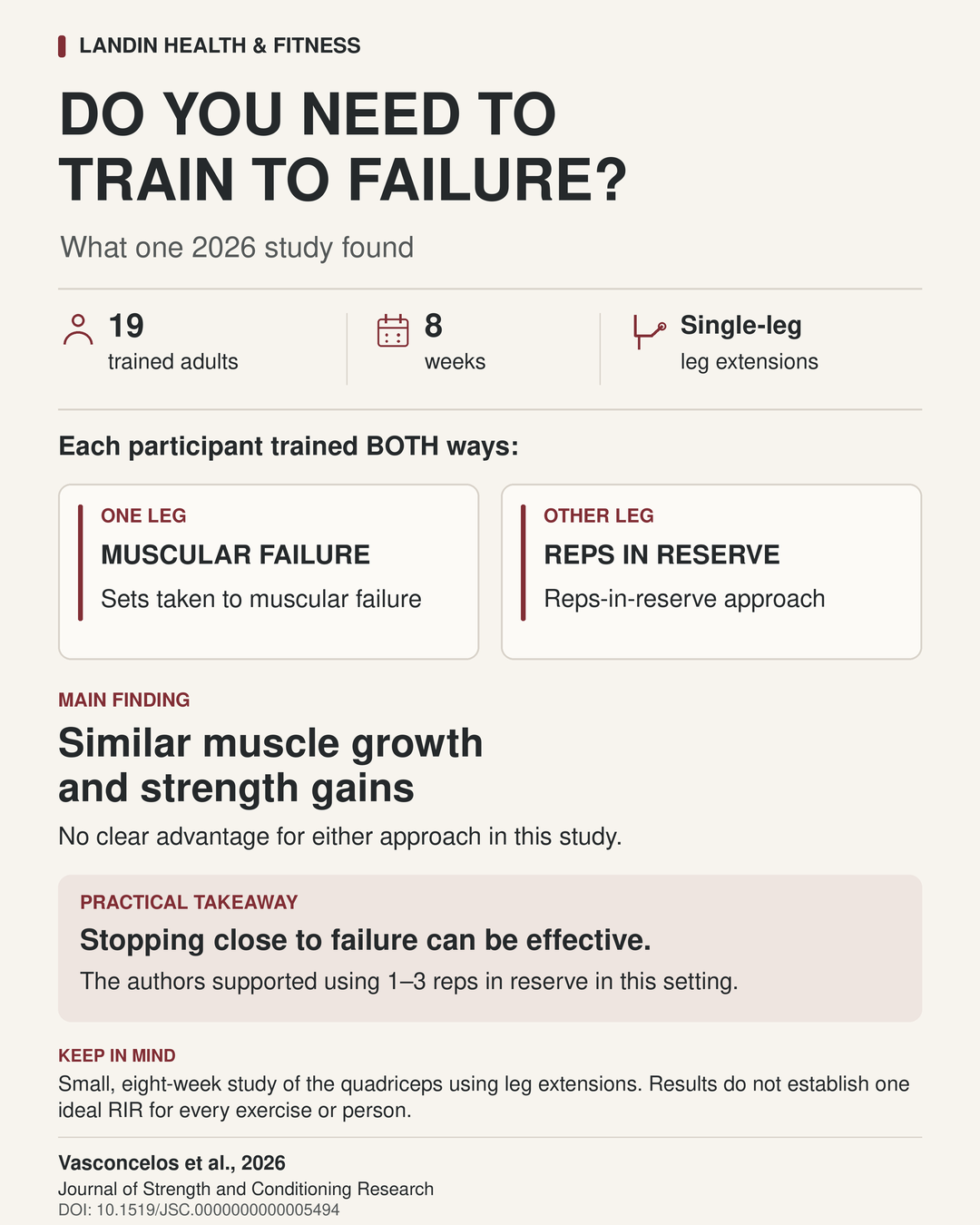
A 2026 study co-authored by Refalo compared failure and a reps-in-reserve approach using leg extensions in 19 trained adults. It also found negligible differences in muscle growth and strength over eight weeks, supporting the use of 1–3 RIR in that setting.
That doesn’t mean failure never has a benefit. A 2025 study he co-authored used just one set per exercise and found some modest, uncertain advantages for failure on muscle-growth measures. Strength improvements were similar.
These are individual studies with limits, including short durations and specific training programmes. They support the idea that you can grow muscle without reaching failure every set. They don’t prove that one exact RIR is perfect for every exercise and person.
The real question: do you know what failure feels like?
Although your question might be, “Do I need to train to failure?”, the question I’d ask first is:
Have you ever actually trained to failure? Do you know what it feels like?
In my experience, people often think they can’t get another rep when they’ve actually got several left. I’ve seen people get another five or six after the point where they thought they were finished.
The burning sensation gets uncomfortable, so they assume that’s all they’ve got. But feeling like you want to stop and being unable to complete another rep aren’t always the same thing.
If you stop what you think is two reps from failure, but you could actually have done another six, you’re training further from failure than you intended.
That’s why learning to judge your effort matters.
How I help clients judge their effort
Sometimes, on an appropriate exercise with a safe setup, I won’t give someone a fixed rep target.
I’ll say: “Keep going, and I’ll tell you when to stop.”
I’ll watch their technique and how the speed of their reps changes, while checking how they’re feeling.
I don’t judge it by how much their face grimaces. I’ve got clients who look like they’ve just stubbed their toe from rep one. Then I’ve got others who are close to failure and look completely stoic.
Their face doesn’t tell you the whole story.
Slowing rep speed can be a useful clue when someone is still trying to lift with the same intent. But it doesn’t tell me their exact RIR on its own. The exercise, the weight, their technique and what’s normal for that person all matter.
A 2025 study on bar speed and perceived RIR supports that distinction: the two provide useful information, but they aren’t interchangeable.
The aim is to help the client recognise the difference between “this is uncomfortable” and “I genuinely couldn’t complete another good rep”.
If you’re exploring that on bigger lifts such as squats or bench press, use an appropriate rack with correctly positioned safeties and a competent spotter where needed. Don’t deliberately test your limit alone under a bar without a way to fail safely. A suitable machine exercise can be a more straightforward place to practise.
So, should you train to failure?
You don’t need to reach failure every set to get great results.
My usual starting point is to leave around one or two reps in reserve on most working sets, adjusting that to the person and programme. Sometimes three may be appropriate too.
Occasional sets closer to failure can help you check your estimates and remind yourself what a hard set feels like. That’s a coaching option, rather than something everyone must do on every exercise.
I use RIR to balance challenging training with fatigue and recovery. I also want clients to track their reps, weights and technique, so we can see whether they’re progressing.
You don’t get extra points for making every set look horrendous. But you do need to be honest about how much you’ve actually got left.
Want help getting more out of your training?
If you’re not sure how hard you should be training, which weights to use or when to progress, that’s something I can help with.
I offer personal training at PureGym Altrincham and online coaching. Drop me a message and we can chat about your training, your goals and what you need help with.
